Twin Curved-Plate Inlet Splitter
Material: Sheet-metal parts, supports and joining consumables specified separately; 304 or 316L requests require factory review
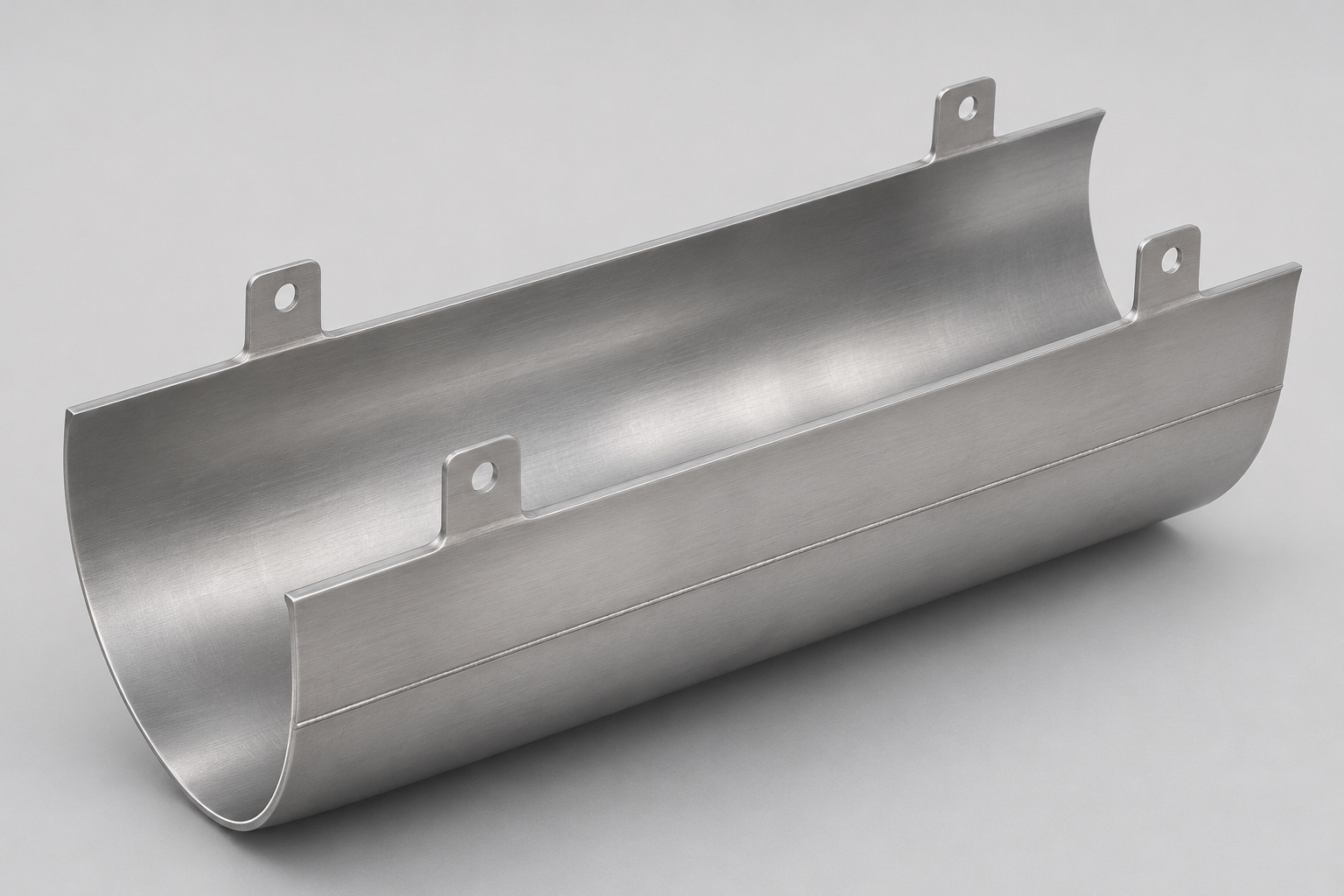
A drawing-defined open-ended inlet splitter made from two curved sheets and mounting ears, for reviewed vessel-entry flow arrangements.
Specification review
- Structure
- Two rolled curved sheet halves, open ends, longitudinal seam and mounting ears
- Geometry
- Radius, length, thickness, seam and ear/hole layout to drawing
- Interface
- Entry direction, vessel supports and duty acceptance reviewed separately
Material and specification review
Two rolled curved sheet halves, open ends, longitudinal seam and mounting ears
Specify these parameters separately
- Curvature, seam and open-end geometrymm
- Provide radius, length, thickness, developed edges, seam details and open-end shape.
- Mounting-ear and inlet interfacemm
- Provide ear/bolt-hole layout, top-entry direction, vessel/support drawings and clearances.
- Inlet-duty and support validation—
- Designer defines actual inlet flow, forces, corrosion and agreed tests; no separation or pressure-loss rating.
Unspecified dimensions, ratings and tolerances remain unconfirmed. Attach drawings, samples or equipment-interface details; the agreed document defines the final specification.
Typical applications
- Reviewed top-entry separator inlet arrangements
- Replacement curved inlet fabrication to approved vessel drawings
- Dry mounting, envelope and maintenance-access review samples
Customizable details
- Curvature, length, thickness and open-end geometry
- Longitudinal joint and sheet-edge preparation
- Mounting-ear positions, hole pattern and support interface
- Sheet/ear/weld grades and agreed surface preparation
Before you request a quote
- Vessel and top-entry nozzle drawings, orientation and available envelope
- Actual gas/liquid inlet duty, corrosion, cleaning and designer acceptance criteria
- Curved-sheet radius/length/thickness, seam and mounting-ear/hole drawings
- Support/load review, agreed sample tests, quantity, destination and packing
Quality checkpoints
- Curvature, both open ends, overall envelope and seam
- Four-ear illustrative pattern checked against approved mounting drawing
- Edge deburring, weld acceptance and clearance inspection
- Designer-defined support and inlet-duty sample validation
Structure and function
Two smooth curved sheet halves form one elongated open half-round trough with a longitudinal centre seam and four mounting ears, two on each upper long edge. Both ends remain open. This drawing example is a simple curved-plate inlet splitter for a separately engineered top-entry vessel arrangement. It is distinct from a deep zigzag vane mist module, mesh pad, duct louver or machine-guard door.
Material selection
Specify curved-sheet, ear-plate and joining-consumable grades independently. 304/316L requests require review of sheet availability, curvature, welds, corrosion and cleaning; alternative alloys are separately assessed. Appearance does not establish material certification, erosion resistance or a temperature/pressure limit.
Dimensions and custom range
Provide arc radius, length, sheet thickness, developed edges, seam preparation, ear dimensions and hole locations, plus vessel/nozzle orientation and clearances. Feasible rolling/forming range, joining method and tolerances follow drawing/sample review. Four ears illustrate one layout, not a universal mounting pattern.
Rolling and joining
Review sheet cutting, rolling of the two curved halves, alignment in a fixture, longitudinal joining, ear fabrication/joining, deburring and cleaning. Confirm shape retention and fit with a dry sample before production. The proposal does not include vessel pressure-shell fabrication or a proprietary multi-vane inlet system.
Entry and support selection
The vessel/process designer defines inlet direction and duty, flow forces, support details, required clearances and validation. Review the two open discharge ends and maintenance access against the vessel drawing before any installation. No separation efficiency, pressure-loss, shear or capacity rating is claimed. Application footage shows a removed uninstalled part beside an isolated empty vessel.
Packing and dispatch
Use shaped external supports to protect the curved shell and keep crate walls clear of mounting ears. Protect open edges without blocking them with loose packaging. Agree handling points, quantity and destination-specific protection. Generated illustrations show conceptual packing and dry application, not actual factory/customer shipment records.
MOQ and lead time
MOQ, feasible dimensions and lead time follow drawing/sample, material, tooling, inspection and quantity review. Below-MOQ sample inquiries are accepted for factory review. Confirm packing, destination and dispatch requirements before scheduling. No stock, price or delivery date is implied.