Chevron Vane Mist Eliminator Module
Material: Specified stainless sheet; vane, sideplate and support grades reviewed independently
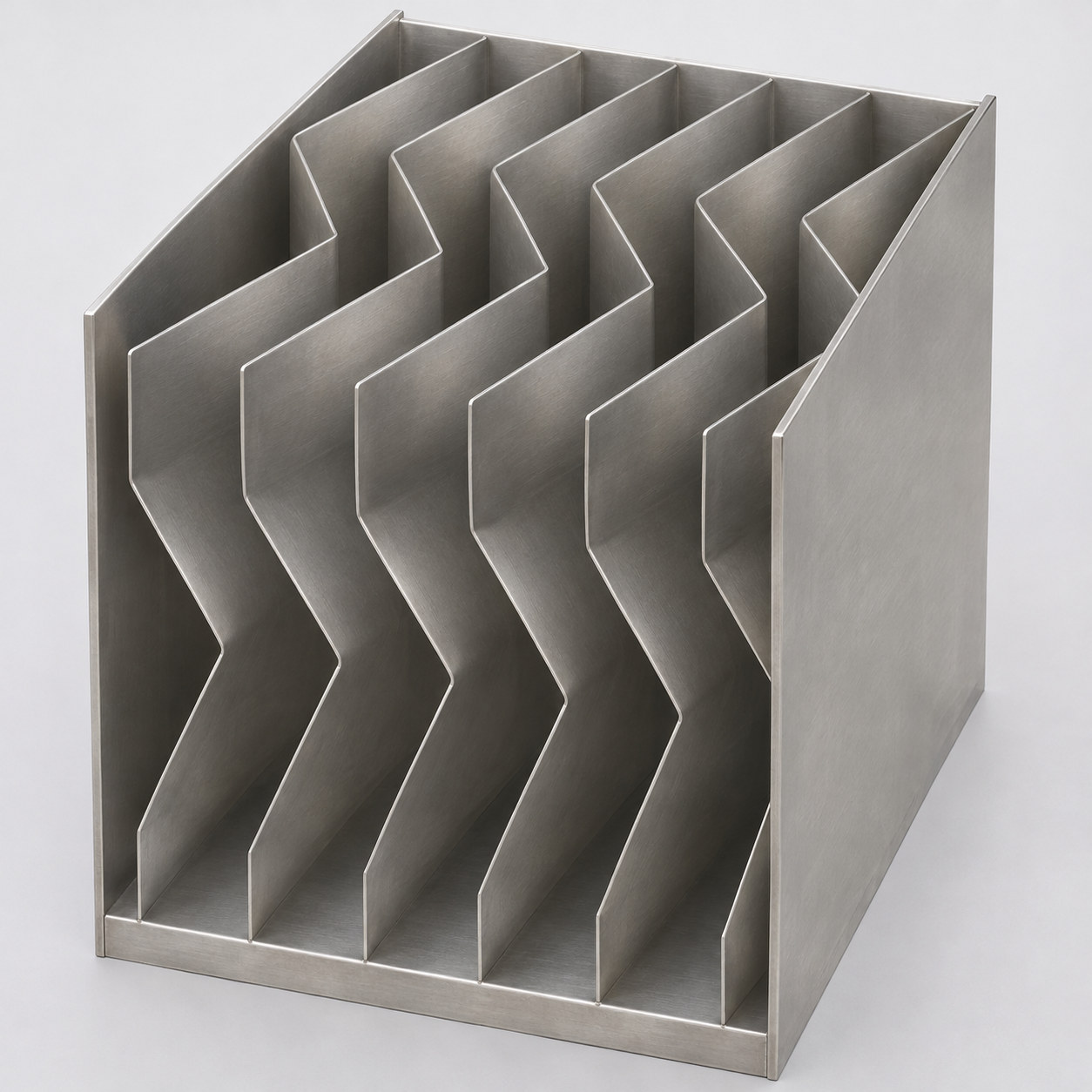
A drawing-defined bank of folded solid-sheet chevron vanes and supports, providing an open drainage-oriented gas path for independently reviewed mist-separation duty.
Specification review
- Structure
- Folded solid-sheet chevron vanes, sideplates and support rail
- Geometry
- Module outline, vane profile, pitch and thickness to drawing
- Interface
- Flow direction, drainage, vessel support and access by review
Material and specification review
Folded solid-sheet chevron vanes, sideplates and support rail
Specify these parameters separately
- Module and vane geometrymm
- Provide outline, vane count, double-bend profile, pitch, thickness and tolerances.
- Flow, drainage and vessel interfacemm
- Specify flow direction, drainage, sideplate/rail mounting, access and support drawings.
- Process and sample validation—
- Provide gas/liquid duty, corrosion/cleaning and agreed tests; no capture or pressure-loss rating.
Unspecified dimensions, ratings and tolerances remain unconfirmed. Attach drawings, samples or equipment-interface details; the agreed document defines the final specification.
Typical applications
- Reviewed scrubber or absorber internals
- Drawing-defined process-vessel vane banks
- Dry fit and drainage-layout sample evaluations
Customizable details
- Module width/height/depth and access segmentation
- Solid-sheet vane profile, bends, pitch and thickness
- Sideplate, rail, drainage and hold-down interfaces
- Material/finish and process acceptance reviewed independently
Before you request a quote
- Vessel/access drawing, flow direction and drainage layout
- Module outline, vane count/profile/pitch/thickness and tolerances
- Vane/support material standards, medium, corrosion and cleaning conditions
- Gas/liquid duty, agreed separation/pressure-loss tests, quantity and destination
Quality checkpoints
- Vane profile and spacing consistency
- Module outline, supports and edge/weld condition
- Dry vessel/access fit and reviewed drainage path
- Duty-specific performance only by agreed tests
Structure and function
Plain folded solid-sheet vanes form repeated chevron paths within an open support module. The illustration uses six two-bend vertical vanes, two sideplates and a bottom support rail as one drawing example. It has no woven/knitted media and no grease-filter handles or overlapping front/rear baffle cassette. It is not a complete separator vessel.
Material selection
Specify stainless-sheet grade and standard separately for vanes, sideplates, rails, drainage parts and joining consumables. Requests for SS304/SS316L or other alloys require independent supply, bend and corrosion review. Plastic/FRP constructions shown by other suppliers are different manufacturing routes and are not offered by this sheet-metal illustration.
Dimensions and custom range
Provide module width/height/depth, access splits, vane count, sheet thickness, bend profile/angle/radius, spacing and support dimensions. Drainage and hold-down details require vessel drawings. Feasible ranges and tolerances follow drawing/sample review; no micron cut size, gas capacity or pressure-loss figure is established.
Fabrication and sample review
The proposed route uses sheet cutting, reviewed folding/rolling, support preparation, joining, deburring and cleaning already within the stated fabrication processes. Agree the actual bend tooling, edge/weld acceptance and sample fit before production. No proprietary supplier vane profile or drainage-pocket design is copied.
Installation and process selection
The process designer defines flow orientation, gas/liquid duty, drain routing, support/retention and access. Isolate equipment before fitting or service and validate the complete installed system under agreed conditions. Dry application media show an uninstalled module near a vessel; no separation efficiency, emission guarantee, temperature limit or process approval is claimed.
Packing and dispatch
Use reviewed outside supports and separated cells to protect vane edges without filling or crushing flow channels. Confirm cleanliness, transport restraint and destination requirements. Generated packing/application media are proposals, not actual factory photography or completed customer shipments.
MOQ and lead time
MOQ, dimensional feasibility and lead time require drawing/sample, material, tooling and quantity review. Below-MOQ samples require factory review. No stock, price or delivery date is promised.